Daily workflow focus
The work-today framing is concrete and makes the case study about operator productivity rather than passive recordkeeping.
Operator workspace for meetings, papers, minutes, actions, and support flows, designed around day-of-meeting preparation and follow-up.
Screen walkthrough
This gallery shows progression, not just a single hero frame. Use it to talk through navigation depth, records, analytics, and workflow context during a call.
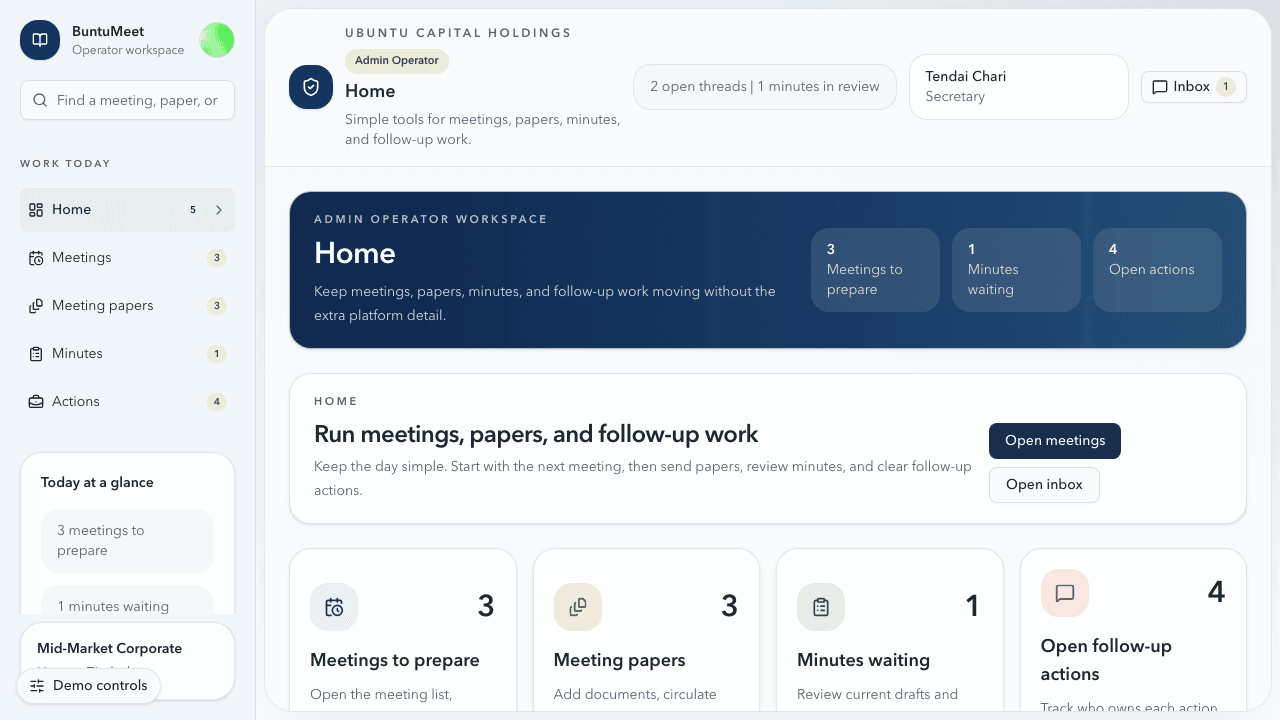
Primary interface capture used for the listing card and story lead.
Overview
BuntuMeet gives the portfolio a clean governance-workflow story. The interface is centered on meetings, papers, minutes, and actions, with a work-today summary that makes the product feel like an execution tool for operators instead of a generic document portal.
Strongest story angle
Tell it as meeting operations software that reduces administrative drag around governance and executive coordination.
Observable modules
Why this one works
The work-today framing is concrete and makes the case study about operator productivity rather than passive recordkeeping.
Meetings, papers, minutes, and actions create a clear story around board or committee administration workflows.
This is useful because it broadens the portfolio beyond finance and logistics into governance and coordination software.
Motion outline
Open on the operator workspace and work-today summary.
Move across meetings, papers, minutes, and actions with concise labels.
Close on the value line: governance work that actually moves forward.
Next publishing pass
The structure is now cleaner: better screenshots, stronger conversion paths, and shared page chrome that behaves correctly. The next layer is adding repository-backed build notes and verified outcome data.
Still worth adding